
GST on Under-Construction Apartments Explained
GST on an under-construction apartment in India stands at 5 percent for regular homes and 1 percent for affordable housing, and both rates apply without any input tax credit for the builder. This tax gets added on top of your agreement value, and it applies only while the project is still under construction. Once a builder gets the completion certificate, GST no longer applies at all. This guide breaks down how the rate actually works, who pays what, and what this looks like in real rupee terms using Sobha Wisteria in Siruseri as a working example.
Why GST Applies Only to Under-Construction Homes
GST treats an under-construction flat as a service, since the builder is still constructing the unit at the time you pay for it. A ready-to-move flat with a completion certificate counts as an already-built asset, not a service, so GST does not apply to it at all. This single difference is the reason two identical flats in the same project can carry very different tax bills, depending on whether you book before or after the completion certificate comes through.
Buyers often assume a ready flat costs less because the builder skips a step. In reality, a ready flat usually costs the same or more per square foot. The absence of GST simply removes one extra cost layer from your final bill.
GST Rates for Different Categories of Housing
The GST Council splits residential property into two categories for this purpose, and the rate you pay depends entirely on which one your apartment falls into.
| Category | GST Rate | Input Tax Credit |
|---|---|---|
| Affordable housing (up to Rs. 45 lakh, within defined carpet area limits) | 1% | Not available to the builder |
| Regular or premium housing (above the affordable housing limits) | 5% | Not available to the builder |
| Ready-to-move flat with completion certificate | No GST | Not applicable |
Affordable housing carries strict limits on both price and carpet area, generally 60 square metres in metro cities and 90 square metres elsewhere, alongside the Rs. 45 lakh price cap. A premium coastal project like Sobha Wisteria, where prices start well above this cap, falls squarely into the 5 percent regular housing category across every configuration it offers.
How GST Is Calculated on Your Agreement Value
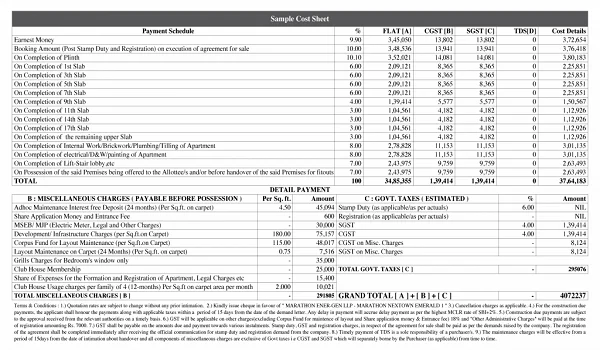
GST applies to your total agreement value, not to your registration or stamp duty charges, which are governed by separate state level rules. The 5 percent regular rate gets applied directly to the price you agree to pay the builder for the apartment, and this amount adds on top of that price rather than getting absorbed into it.
Here is how this plays out across different configurations at a project like Sobha Wisteria, using the current indicative pre-launch pricing.
| Configuration | Indicative Price | GST at 5% |
|---|---|---|
| 2 BHK | Rs. 1.85 Cr to Rs. 2.18 Cr | Rs. 9.25 Lakh to Rs. 10.90 Lakh |
| 3 BHK Compact | Rs. 2.52 Cr to Rs. 2.86 Cr | Rs. 12.60 Lakh to Rs. 14.30 Lakh |
| 3 BHK Premium | Rs. 3.02 Cr to Rs. 3.53 Cr | Rs. 15.10 Lakh to Rs. 17.65 Lakh |
| 3 BHK + Study | Rs. 3.70 Cr to Rs. 4.03 Cr | Rs. 18.50 Lakh to Rs. 20.15 Lakh |
| 4 BHK | Rs. 4.70 Cr to Rs. 5.88 Cr | Rs. 23.50 Lakh to Rs. 29.40 Lakh |
These figures move with the final confirmed price sheet, so treat them as a working guide rather than a fixed billing figure. GST is usually collected in instalments, matching the same construction linked payment schedule the builder follows for the base price itself.
Why Builders Cannot Claim Input Tax Credit
Before 2019, builders charged a higher GST rate but could offset it using input tax credit on materials like cement and steel. The government later removed this credit option and cut the headline rate instead, moving builders to the current 5 percent and 1 percent structure without any offset. This shift aimed to simplify pricing and stop the wide variation in how different builders passed on their tax savings to buyers. In practice, it means the rate you see quoted today is close to the final number, without hidden adjustments buried inside the builder's cost sheet.
What Buyers Often Get Wrong About GST
A few misunderstandings come up again and again with under-construction purchases.
- GST is not the same as stamp duty or registration charges, and all three apply separately on your total cost.
- GST stops applying the moment a project gets its completion certificate, even if you book just before that date.
- The rate depends on the apartment's price and size category, not on which state or city the project sits in.
- GST applies to the base agreement value only, not to optional charges like car parking or club membership, which may carry their own tax treatment.
FAQs
Regular under-construction homes attract 5 percent GST, while affordable housing attracts 1 percent. Both rates apply without input tax credit for the builder.
No. Once a builder receives the completion certificate, the flat counts as a completed asset rather than a service, and GST no longer applies.
Since every configuration at Sobha Wisteria falls under the regular housing category, GST works out to 5 percent of the agreement value, ranging from roughly Rs. 9.25 lakh for a 2 BHK to nearly Rs. 29.40 lakh for a 4 BHK at current pre-launch pricing.
No. GST applies only to the agreement value of the property itself. Stamp duty and registration follow separate state level rules and get calculated independently.
The government removed this option in 2019 and lowered the headline GST rate at the same time, aiming to simplify pricing and reduce inconsistency across builders.
Not automatically. The home must also meet carpet area limits, generally 60 square metres in metro cities and 90 square metres elsewhere, along with the price cap.
Understanding GST before you book an under-construction apartment helps you budget accurately from day one. Confirm the exact GST category and amount with your builder's official cost sheet, since this figure adds directly to your total outlay alongside stamp duty and registration charges.